
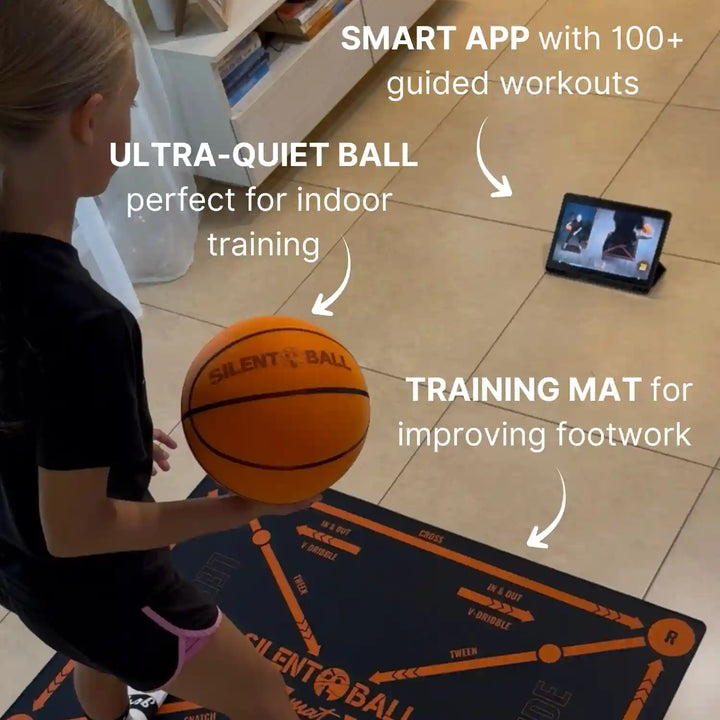
Modern basketball training increasingly relies on data-driven methods. Players and coaches now measure progress through repetition counts, reaction time, balance efficiency, and movement accuracy. A basketball training mat designed for footwork, dribbling, and movement control fits naturally into this statistics-focused approach. By providing structured visual cues and measurable patterns, the mat transforms everyday drills into trackable performance sessions.
Why Do Training Mats Matter in Skill Development?
From a performance analysis perspective, foot placement and body positioning directly affect speed, control, and decision-making. Training mats are built with marked zones, numbered steps, and directional guides that encourage consistency. According to training observations, athletes who practice with visual footwork references reduce unnecessary steps and improve balance efficiency over time. These improvements are not accidental; they are the result of repeated exposure to standardized movement patterns.
Unlike free-form drills, a mat creates a controlled training environment. This allows players to focus on accuracy before speed, which is a core principle in long-term skill acquisition.
How Does a Basketball Training Mat Improve Footwork?
Footwork is often measured by reaction speed, stability, and transition accuracy. A training mat supports these metrics by guiding players through predefined step sequences. Each drill can be repeated with minimal variation, making it easier to compare performance from one session to another.
Statistical training logs often show that players using structured footwork tools demonstrate improved lateral movement and quicker directional changes. Over weeks of consistent practice, the reduction in missteps becomes measurable, highlighting the mat’s role in building muscle memory.
Can Dribbling Control Be Measured with a Training Mat?
Dribbling efficiency is closely linked to body alignment and hand positioning. Training mats introduce spatial awareness by forcing players to dribble within specific zones. This encourages tighter ball control and improved coordination between feet and hands.
From a data standpoint, coaches can count successful repetitions, track error rates, and observe dribble consistency. Over time, players tend to reduce off-balance dribbles and unnecessary hand switches. These improvements align with statistical trends showing better ball security during live play.
What Role Does Movement Control Play in Overall Performance?
Movement control connects footwork and dribbling into one fluid system. A basketball training mat supports this integration by combining directional cues with dribbling paths. Players are required to move, stop, pivot, and react within defined boundaries.
This structure helps measure control under pressure. For example, reaction drills performed on a mat often show faster completion times and fewer positional errors. When repeated consistently, these drills contribute to better court awareness and decision efficiency.
Is the Training Mat Suitable for All Skill Levels?
Data collected across training environments suggests that structured tools benefit both beginners and advanced players. Beginners gain clarity and confidence by following visual guides, while experienced athletes use the mat to refine precision and consistency.
Because drills can be adjusted in complexity, the mat scales with the player’s development. This adaptability makes it a valuable long-term training asset rather than a short-term learning aid.
How Does a Training Mat Support Consistent Practice?
Consistency is a key variable in performance improvement. A basketball training mat encourages regular practice by simplifying drill setup and reducing guesswork. Players know exactly where to step and how to move, allowing them to focus on execution.
From a statistical viewpoint, consistent environments produce more reliable performance data. This makes it easier to evaluate progress, identify weaknesses, and adjust training intensity.
What Makes a Basketball Training Mat a Data-Friendly Tool?
The strength of a training mat lies in its ability to standardize movement. Standardization enables comparison, and comparison drives improvement. When drills are repeatable, performance becomes measurable.
In a sport where small improvements can influence game outcomes, tools that support measurable growth are essential. A basketball training mat does exactly that by merging physical training with structured analysis.
In conclusion, a basketball training mat for footwork, dribbling, and movement control is more than a practice accessory. It is a performance measurement tool that supports accuracy, consistency, and long-term skill development through a statistics-oriented training approach.